A significant issue and risk for space vehicles is the acoustic and vibration environment. Ignition Over-Pressure (IOP) and plume reflections off the deck are concerns that need to be mitigated because of risk to the vehicle and payload.
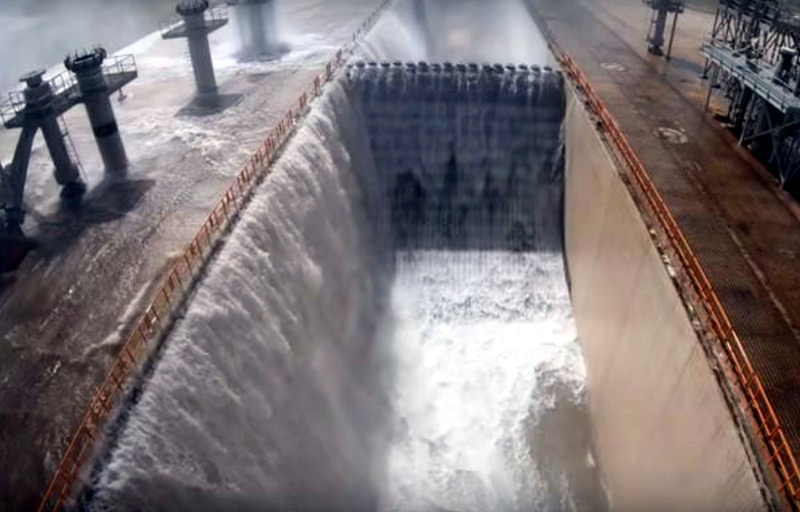
The Space Shuttle historically, and the Space Launch System, have both used sound suppression systems with deluges of water from rainbirds on the deck, pipes in the plume hole, and cascades down the flame trench.
Modeling these systems is challenging for Computatational Fluid Dynamics (CFD) with 10,000 gallon's per minute (gpm) from individual sources, emitted as multi-foot sheets of liquid water, and nearly 900,000 gpm peak flow rates from all systems during launch.
The final products at the time of 2012 involved 1000's of millions of particles, interacting with plumes at ~mach 10 and temperatures of 3,300°C (5,972°F) for the Space Shuttle Main Engine (SSME) and 2,500°C (4,500°F) for the Solid Rocket Boosters.
The software demonstrated stability, bouncing, cascading, water sheets on complex hardware, evaporation, plume energy absorbing, and visible reductions in acoustics that matched well with test data available.
At Marshall Space Flight Center (MSFC) this was a known issue for Liftoff Debris, and work was contracted to Mississippi State Univerity (MSU) to develop a large-scale lagrangian particle system appropriate for parallelized CFD with the Loci/CHEM software.
My work at MSFC involved collaborating with MSU, testing and validating features, providing feedback on deficiencies or improvements, creating and evaluating unit problems, stress testing on large scale (rocket launch pad) problems, and implementing cases needed to address Liftoff Debris risks.
Much credit to Ed Luke of Mississippi State University for the work of developing the lagrangian particle add-on for Loci/CHEM and ER42 of MSFC for employing me to work on the project.
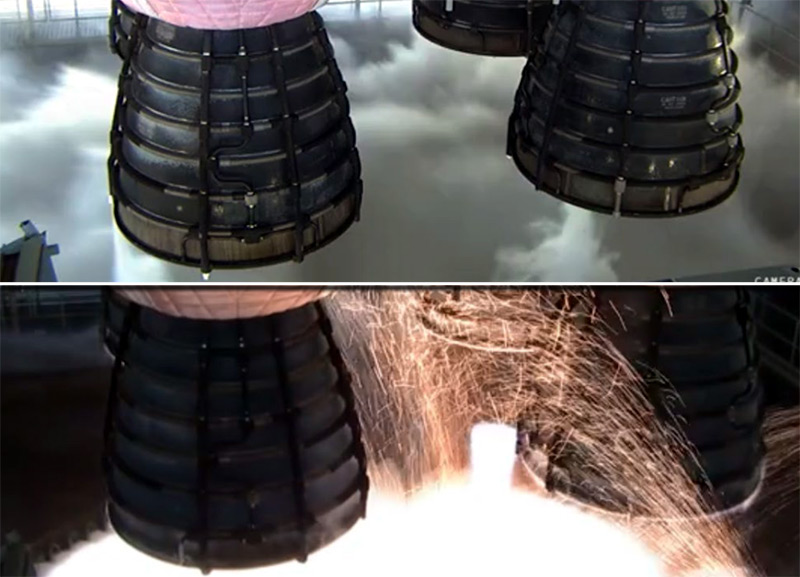
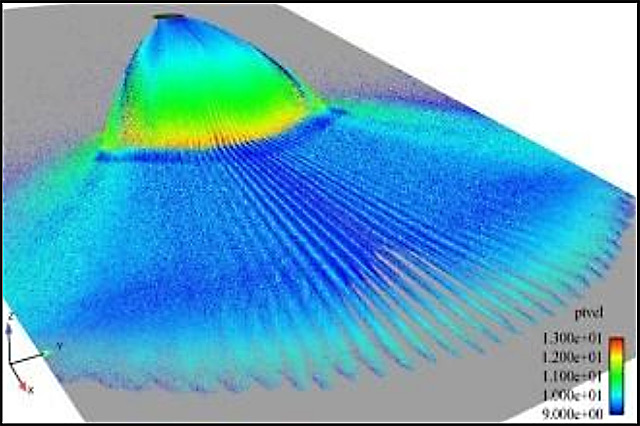
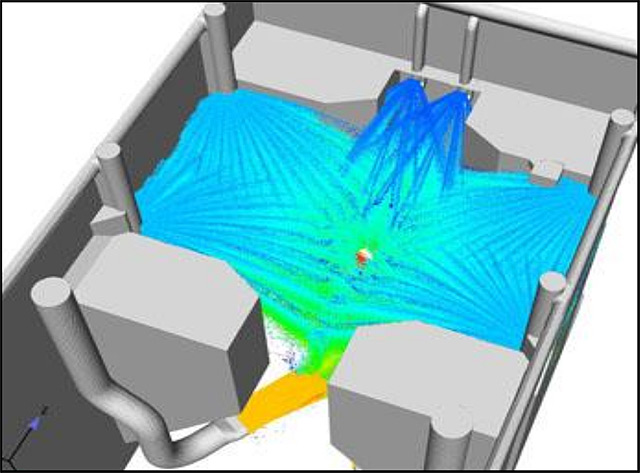
Five (5) images providing reference for the water deluge and sound suppression systems used with the Space Launch System. The first two show rainbird testing on the launch pad and the large volumes of water emitted, the third shows the cascading water effect below deck in the trench, the fourth shows the SRB plume holes in integrated water systems, and the fifth shows imagery from the Space Shuttle Main Engines (SSMEs, or RS-25 model) entraining sound suppression water after startup.
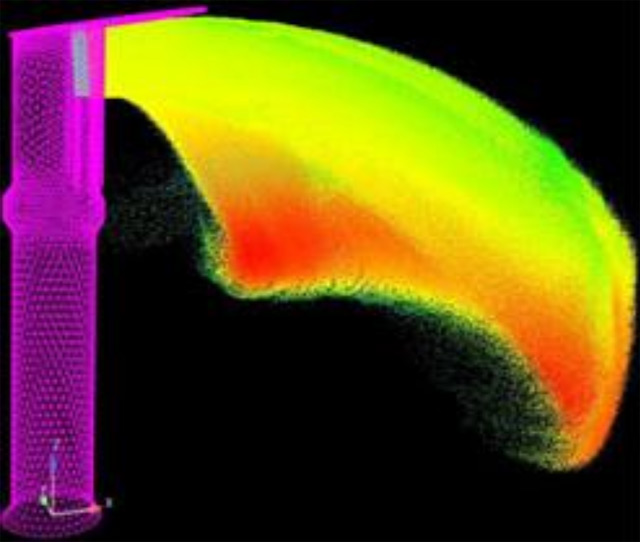
Space Shuttle rainbirds, ejecting water at tens of thousands of gallons per minute (gpm), mid-ejection (1 sec and 3.5 secs) prior to deck impact, in addition to water cascading across the launch pad after deck impact. These tested the Loci/CHEM Lagrangian two-phase model for its ability to achieve full size flow rates from single sources, and for the particle tracking to properly deal with impact, rebound, and surface flow across the launch pad. Injecting massive amounts of water in the form of Lagrangian particles requires a CFD tracking of millions of water droplets.
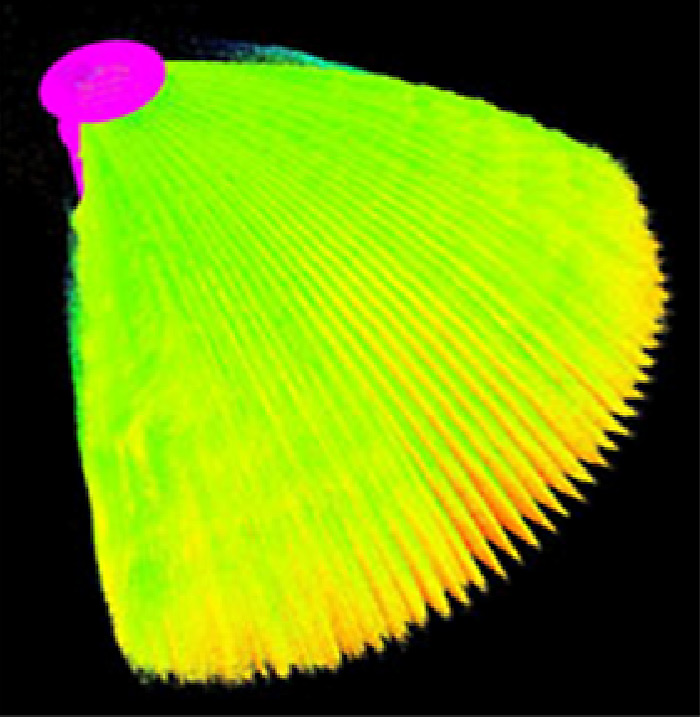
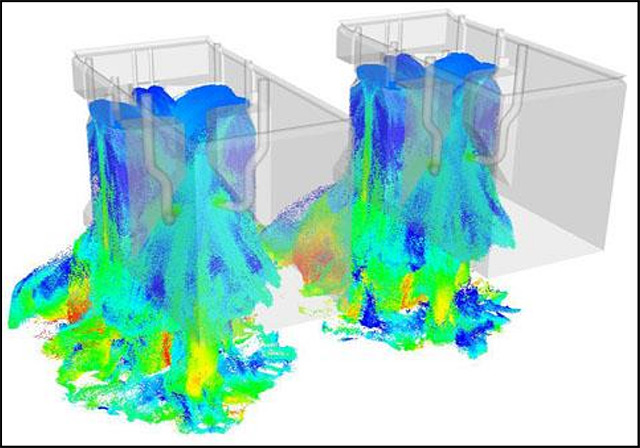
Testing expanded to simulations of the Solid Rocket Booster (SRB) water deluge system for the Space Shuttle. The first image shows water from a single plume hole, while the second shows both SRBs in a 3D see-thru configuration. Thousands of gallons per minute (gpm) of water are ejected from multiple opposing orifices in each SRB hole. These full-scale subsystem cases helped select suitable particle sizes, parameters for particle breakup and phase transition modeling, and interaction with solid walls. While the model handles exchange of mass, momentum and energy between the phases, particles were not aware of neighboring particles and had no particle-particle interaction. This lead to amassing of water droplets in computational cells resulting it excessive local densities. Collisions, agglomeration and deflection of particles were modeling difficulties.
💦 NASA, CFD, SLS Plume 500 K Iso Surface, Water Reduction, 0.7 to 4.5 secs
🕵🏻
G. C. Putnam
🛈
A zoomed out, side by side comparison of the plume environment for the full Ares V launch pad in both dry configuration and water deluge configuration. From far away, a visible reduction in the on-deck plume regions above 500 K in temperature can be seen with water addition. The vehicle was held at a fixed height in space, and the water deluge environment had four on-deck rainbird systems activated and injected in excess of a 100,000 gallons per minute of water in total.
💦 NASA, CFD, SLS Plume, Zoomed-In, Water Cascade and Plume Interaction Effects
🕵🏻
G. C. Putnam
🛈
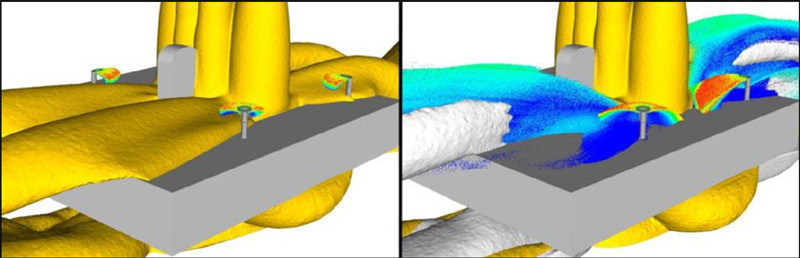
A zoomed in, side by side comparison of the plume environment for the full Ares V launch pad in water deluge configuration, showing the rainbirds just after activation on the left, and 4.5 seconds after activation on the right, once plume impingement and reduction are well under way. Plume impact regions above 500 K in temperature have been almost completely eliminated above the deck surface, and proper transition of a 100,000 gallons per minute of particulate water to gas phase steam can be observed.
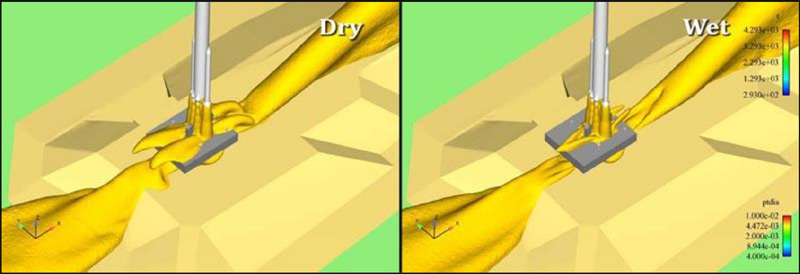
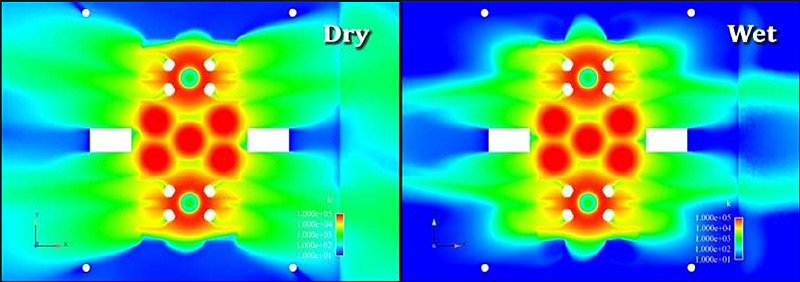
A side by side comparison of the turbulent kinetic energy on the mobile launch platform deck, a surrogate measure for acoustic emissions. A dry configuration is shown on the left and water deluge configuration is shown on the right. Almost all of the radiating 1,000+ emissions sources on the deck have been suppressed. This work was then uses to target regions of high turbulence to reduce vehicle damaging noise emissions.
💦 NASA, CFD, ASMAT Water Deluge Experimental Setup Orientation
🕵🏻
G. C. Putnam
🛈
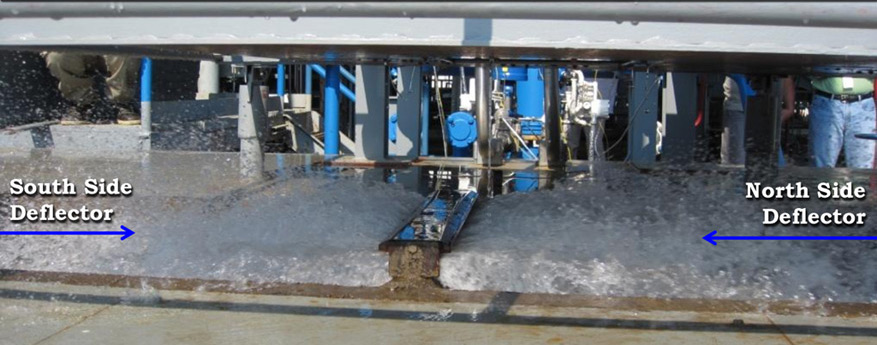
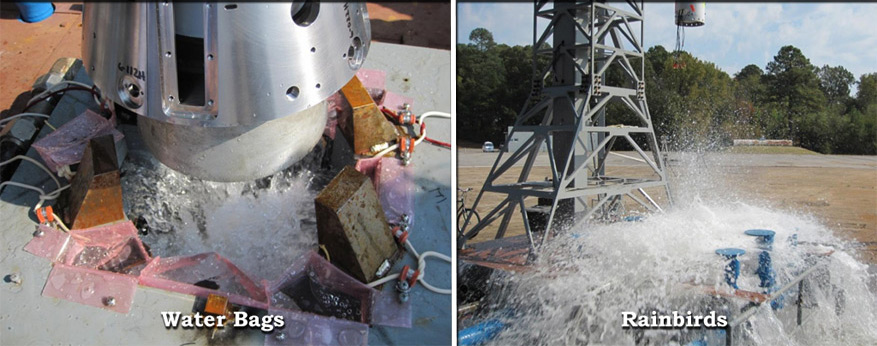
Shown is the various water deluge systems for the Ares Scale Model Acoustic Test (ASMAT). The test was a 5% scale test of the full vehicle with water from rainbirds, water bags that broke on rocket ignition, trench deflectors to oppose plume flow below the deck, and sound suppression system in the mobile launcher and launch mount. Each system could activated independently, and individual combinations were tested to evaluate their need for the full scale vehicle.
💦 NASA, CFD, ASMAT Water Deluge Result, Evaporation, and Demo Video, Supercomputing SC12
🕵🏻
G. C. Putnam
🛈
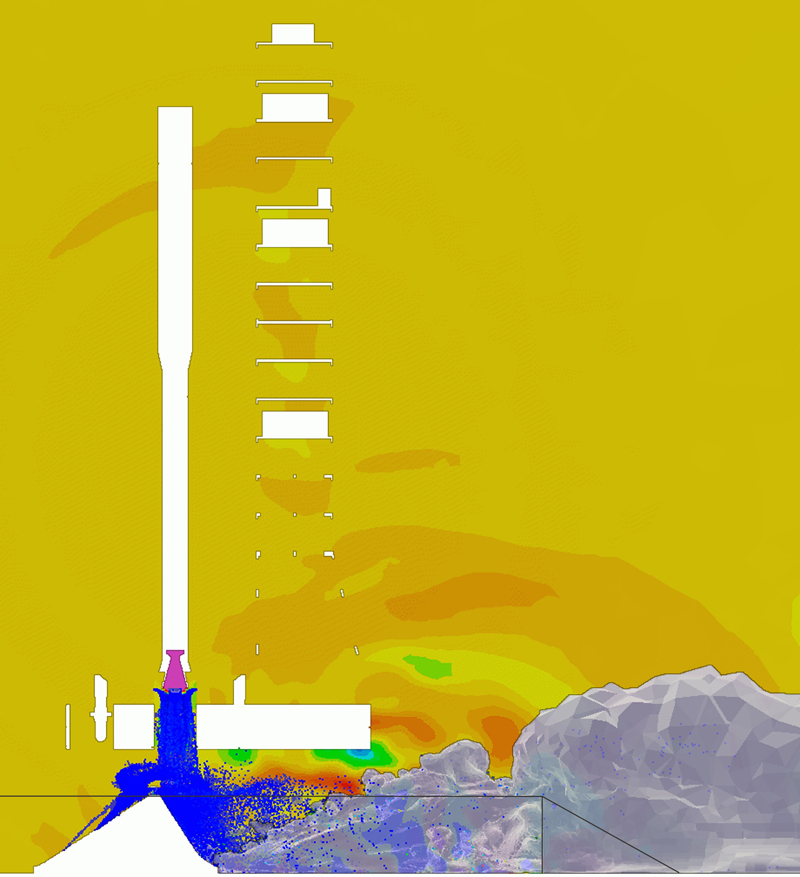
A still-frame image of the ASMAT simulation shown in the video above. Snapshot of pressure contours through the centerline of the rocket with water suppression simulation as the overpressure propagates through the launch tower and a the translucent evaporation cloud of water forms in the flame trench.
🛈
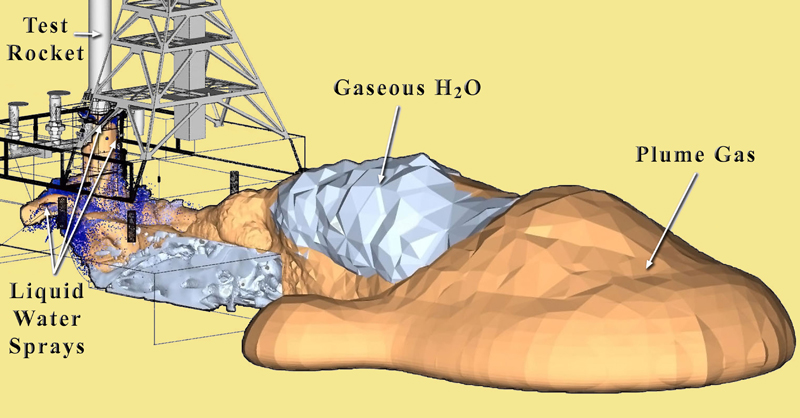
Rocket plume gas and evaporating suppression water interact as the ignition overpressure (IOP) wave propagates through the launch tower. In this held-down ASMAT configuration, water sprays are emitted primarily in the plume path hole (shown as blue particulates), and then mix with the plume gas over the length of the trench, transitioning to gaseous H2O (steam) miway down the trench and at the exit.
🛈
This video shows the Ares Scale Model Acoustic Test (ASMAT), which was a 5% scale model tests of the Ares I vehicle to address vibration and acoustic risks from the Constellation Program. Pressure contours through the centerline of the rocket and water suppression as the rocket ignites, the ignition over-pressure propagates, and the plume stabilizes. The left image is the rocket on a dry launch pad without water suppression, while the right image models water suppression effects. Liquid water droplets can be seen as sprays of blue dots, while evaporated steam is visible as a translucent cloud.